
Introduction
A patient does not experience healthcare as departments. They do not see the difference between scheduling, insurance verification, prior authorization, clinical documentation, coding, claims, payment posting, denial management, and follow-up.
They experience one thing: was it easy to get care, understand what happens next, and trust the process?
For medical practices, this is where the real challenge begins. A practice may have excellent physicians, caring staff, strong clinical quality, and modern systems. Yet patients may still wait too long, staff may still chase insurance answers, claims may still get denied, and leaders may still lack real-time visibility into where operations are slowing down.
That gap is administrative friction. This article explains where it hides and why practice management should be treated as a connected operating system.
The Practice Management Landscape
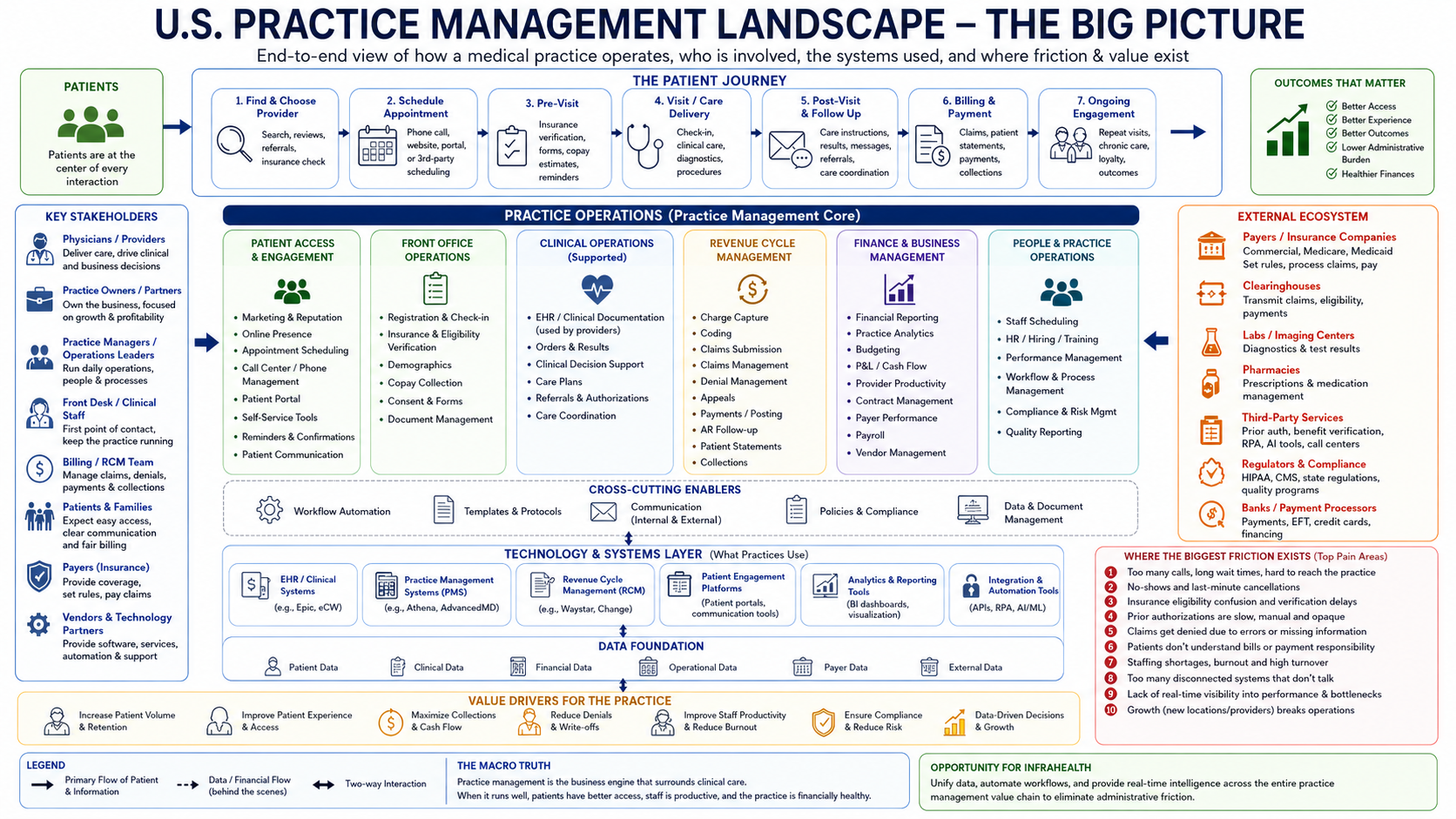
The landscape below is the anchor for this discussion. It shows the full practice management picture: the patient journey, core operations, revenue cycle, external ecosystem, technology layer, friction points, and value drivers.
Why This Matters Now
Why is practice management no longer a back-office topic?
Because the pressure is coming from every direction. Patients expect faster access and clearer communication. Providers want more time for care and less time on paperwork. Staff are stretched. Payers require more documentation. Claims are more complex. Technology stacks are fragmented. Growth adds more locations, providers, workflows, and operational risk.
What does the data suggest?
The 2024 CAQH Index found a $20 billion opportunity to reduce administrative waste by moving more administrative transactions from manual to electronic workflows. The 2024 AMA prior authorization survey found that 94% of physicians reported prior authorization delays access to necessary care. CMS is also pushing toward more interoperable, API-based workflows, with many major prior authorization requirements taking effect by January 1, 2027.
This means practice leaders cannot solve the problem by simply asking already-busy teams to work harder. They need a better operating model.
The Story of a Typical Patient Visit
Imagine a patient who needs to see a specialist. At first, the problem seems simple: find a provider and book an appointment. But behind the scenes, the practice must answer many questions before, during, and after the visit.
Before care
Is the patient active? Is insurance valid? Is the provider in network? Is a referral or authorization needed?
During care
Are forms complete? Is the copay correct? Was the visit documented properly? Are orders and follow-ups clear?
After care
Was the claim coded correctly? Did the payer accept it? Was payment posted? Does the patient understand the bill?
Hidden work
When answers are unclear, staff call, log into portals, re-enter data, wait, message, and follow up again.
This is the hidden cost of practice management. It is not one large failure. It is hundreds of small delays that compound across the patient journey.
Practice Management Is the Business Engine Around Clinical Care
A medical practice is not only a clinical environment. It is also an operating system. That operating system includes six major areas.
The key lesson is simple: these functions are connected. A missed eligibility check can become a denied claim. A documentation gap can become delayed payment. A scheduling issue can become lost revenue. A poor billing experience can damage patient trust. A disconnected system can become staff burnout.
The External Ecosystem Is Where Complexity Multiplies
Even the best-run practice does not control the full ecosystem. Practices depend on payers, clearinghouses, labs, imaging centers, pharmacies, payment processors, regulators, technology vendors, and third-party service providers.
Each external participant may have its own rules, portals, data formats, timelines, and exception processes. The practice is often expected to coordinate everything, but it rarely has full visibility or control.
When systems do not talk to each other, people become the integration layer. That is exactly the type of problem InfraHealth was created to address.
What Potential Clients Should Be Asking
Where are patients waiting unnecessarily?
Where are staff spending time chasing information?
Where are claims getting delayed or denied?
Where are providers losing time to documentation or administrative uncertainty?
Where do leaders lack real-time visibility?
Where does growth create more complexity instead of more leverage?
This is where InfraHealth starts: not with a generic software pitch, but with a diagnostic view of where complexity is slowing decisions, access, payment, and growth.
The InfraHealth Perspective: Remove Steps, Do Not Add Noise
Many healthcare organizations already have software: EHRs, practice management systems, revenue cycle tools, patient portals, billing platforms, reporting dashboards, clearinghouse connections, and call center workflows.
The problem is not always the absence of technology. The problem is that technology does not always create a clean operating flow.
The future of practice management is not more disconnected tools. It is better coordination across the tools, teams, and stakeholders already involved.
How an EXO-First Model Changes the Conversation
InfraHealth is built around a Massive Transformative Purpose: eliminate administrative friction so access to quality healthcare is fast, universal, and inevitable.
Through an EXO lens, practice management friction is mostly an external ecosystem problem. The right approach is not to own every asset or hire endlessly. The right approach is to create leverage through algorithms, existing systems, engagement, community, and expert human review for complex exceptions.
The Business Value for Practice Leaders
A better practice management operating model improves patient access, staff productivity, revenue performance, provider experience, leadership visibility, and scalability.
In simple terms: better practice management protects both patient trust and practice economics. That is why this topic deserves executive attention.
Conclusion: Practice Management Is the Starting Point for Transformation
Practice management connects the patient journey, front office, clinical operations, revenue cycle, finance, staffing, technology, payers, vendors, and compliance. When that system is fragmented, everyone pays the price: patients wait, staff burn out, providers lose focus, claims slow down, revenue leaks, leaders lack visibility, and growth becomes harder.
But when the system is coordinated, access improves, workflows move faster, financial performance becomes clearer, patients trust the process more, staff focus on higher-value work, and leaders scale with confidence.
This is Article 1. The next article will go deeper into patient access and front office operations, the first place where patient experience, operational efficiency, and revenue performance begin to connect.
Talk to InfraHealth ->