
Introduction
Welcome to The InfraHealth Thesis Series, a founder-led series on why InfraHealth exists, why administrative friction slows healthcare access, and how better ecosystem coordination can make care faster, clearer, and more reliable.
Before discussing platforms, technology, AI, or workflow automation, I want to start with the thesis behind InfraHealth. Healthcare access does not break in one place. It breaks across handoffs, across organizations, and across moments where patients, providers, payers, employers, and administrators are trying to move care forward without enough shared visibility.
Administrative friction is one of the most important access problems hiding in plain sight.
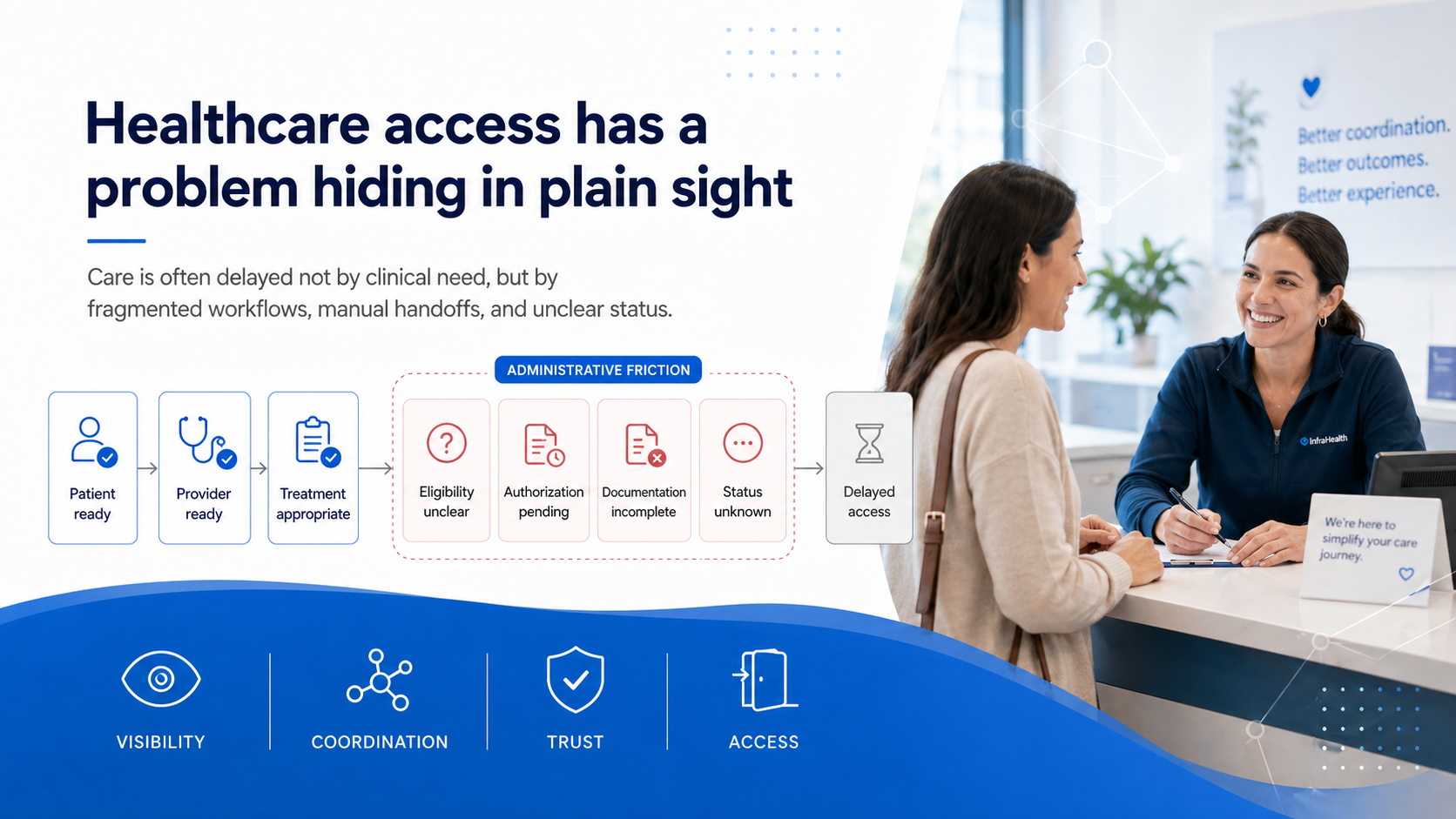
Healthcare Access Has a Problem Hiding in Plain Sight
I launched InfraHealth because I saw a recurring pattern: healthcare access is too often slowed not by care itself, but by the system around care.
A patient may be ready. A provider may be ready. A treatment may be appropriate. But access can still be delayed because eligibility is unclear, authorization is pending, documentation is incomplete, payment responsibility is uncertain, or no one has real-time visibility into what happens next.
For patients and families, administrative friction does not feel administrative. It feels like waiting, confusion, anxiety, repeated phone calls, delayed care, and unanswered questions.
Prior authorization is one visible example. The American Medical Association's 2024 survey found that 93% of physicians reported prior authorization delays patient care, 82% said it can lead patients to abandon treatment, and 94% linked prior authorization to negative clinical outcomes. CAQH also reported a $20 billion opportunity to reduce administrative waste, cut costs, and improve patient access.
The Personal Moment That Made This Mission Real
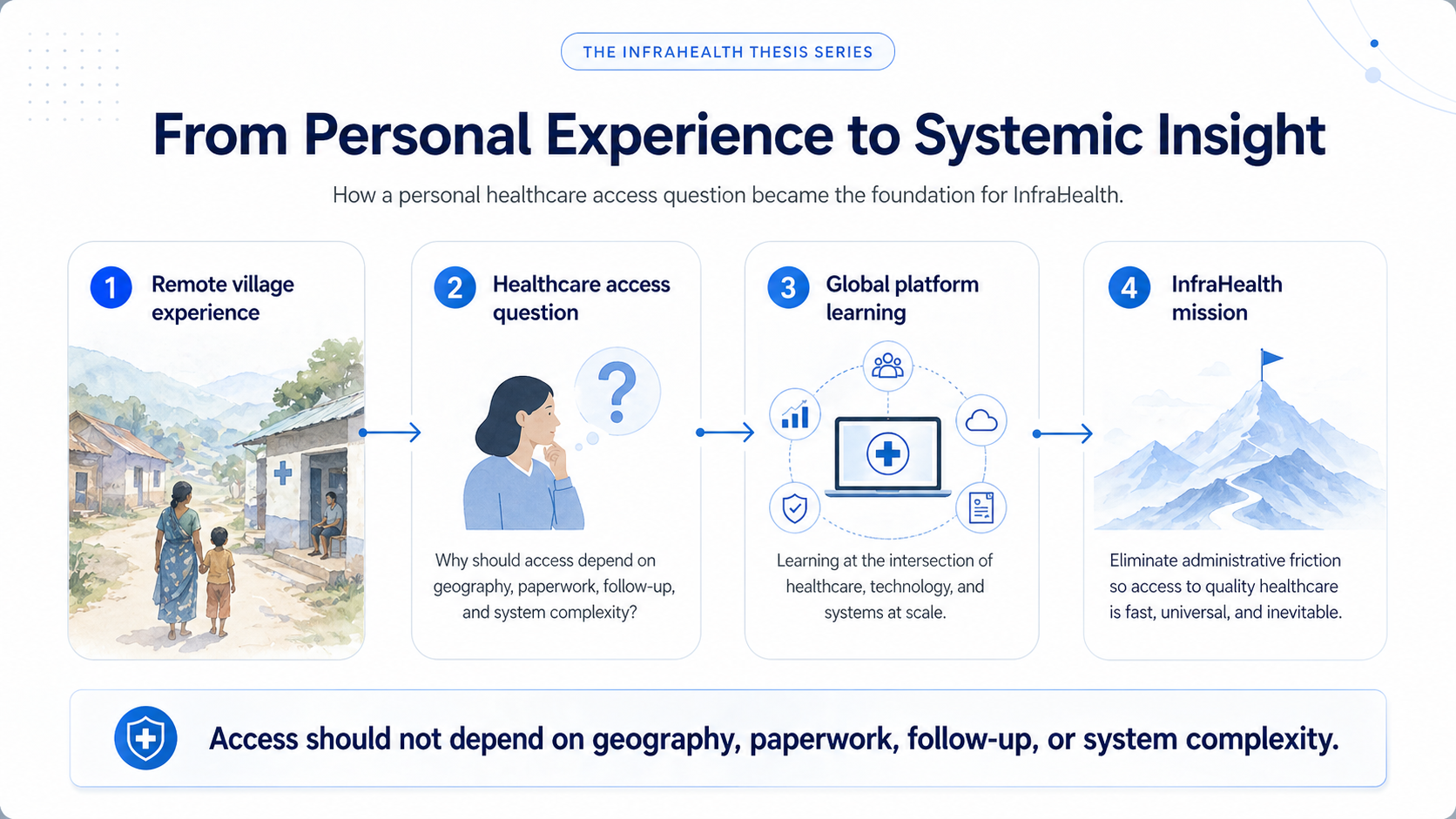
My journey toward InfraHealth began with a deeply personal question: why should access to care depend so much on geography, paperwork, follow-up, and system complexity?
During a visit to my remote village in Pakistan in 2022, I was reminded how deeply healthcare access shapes the lives of families and communities. That experience pushed me to engage more deeply in healthcare, including through my partnership journey with Mentor Health Global.
As I studied healthcare more deeply, I realized this is not only an emerging-market problem. Even in advanced healthcare systems like the United States, patients and providers often face delays because the administrative path to care is fragmented.
Access to care should not depend on who can navigate complexity best.
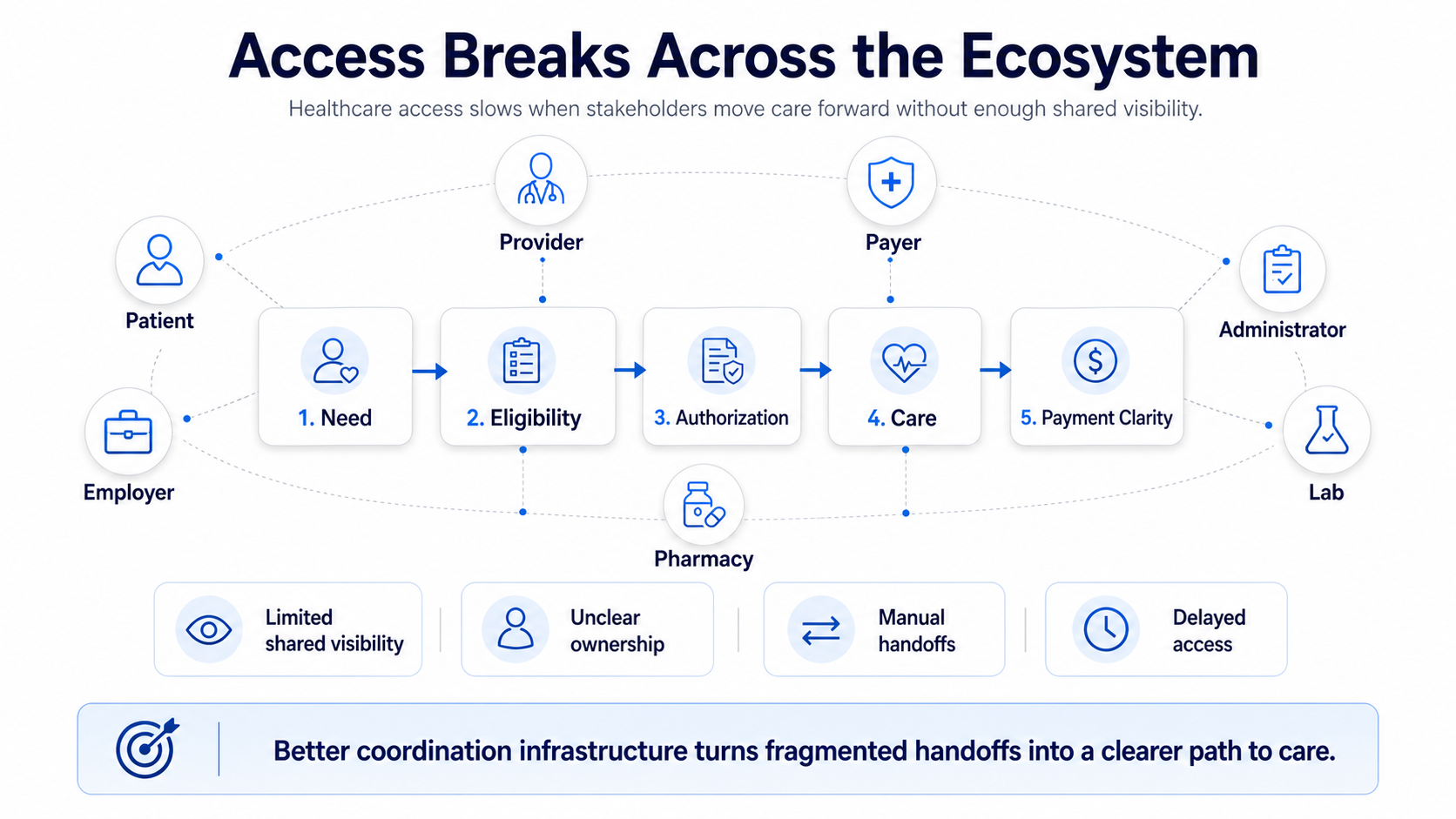
The Insight: Access Is an Ecosystem Coordination Problem
Healthcare is not experienced by patients as separate departments, systems, portals, payers, providers, employers, and administrators. Patients experience one journey.
Behind that journey, many stakeholders must coordinate: providers, payers, employers, benefit administrators, pharmacies, labs, referral partners, care teams, patients, and families. When these stakeholders operate without enough shared visibility, the system slows down.
That is why healthcare access is not only a clinical capacity problem. It is also an ecosystem coordination problem. InfraHealth starts with the end-to-end journey and asks: where is access slowing down, and what coordination layer is missing?
Why My Background Led Me Here
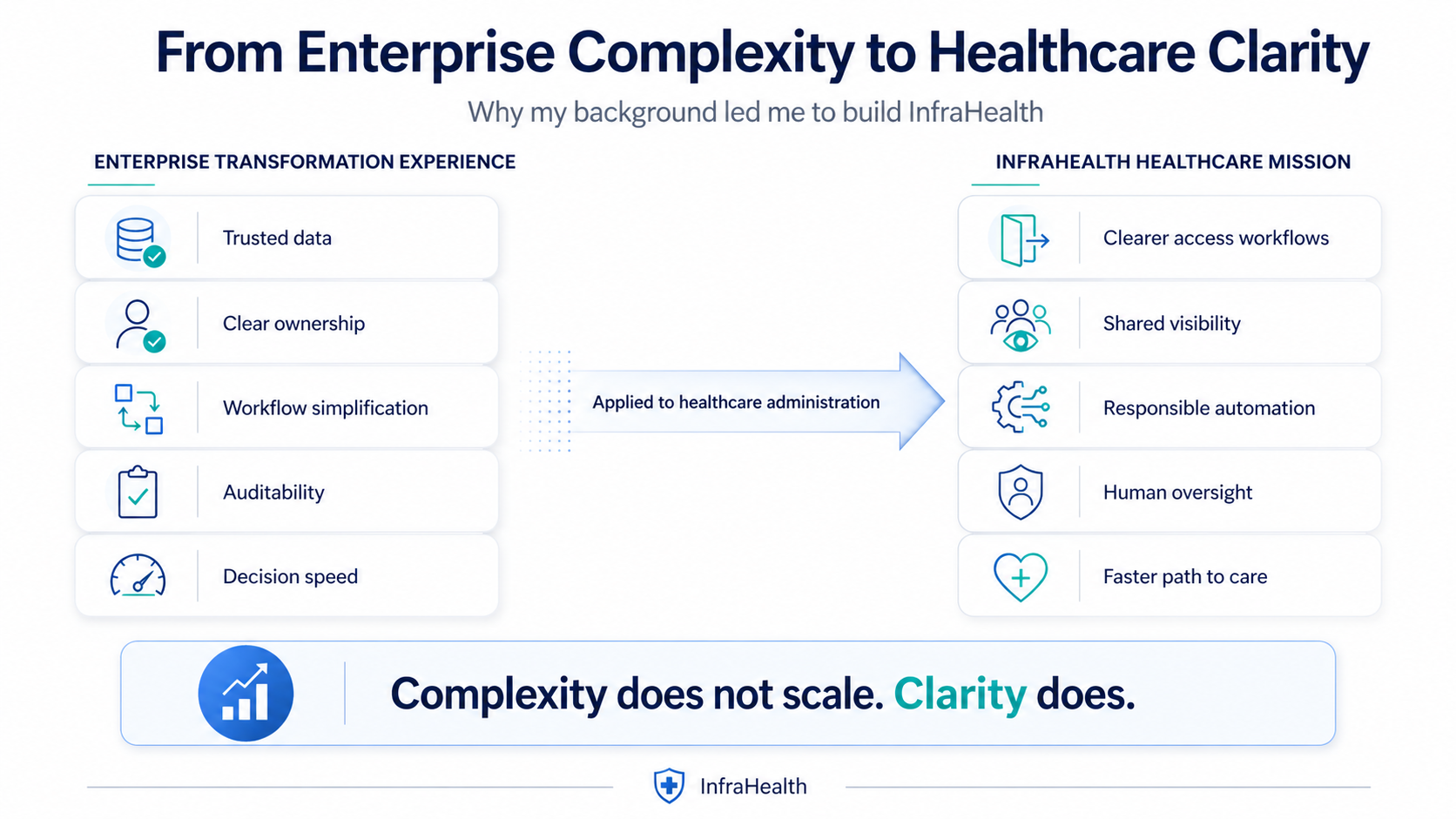
My background is not traditional healthcare operations. That is part of the edge. I have spent more than 25 years helping complex organizations simplify systems, build trusted data foundations, align business and technology leaders, and improve decision flow.
Much of that experience came from financial services, where trust, controls, transparency, auditability, and data quality are non-negotiable. Healthcare is different and must be approached with humility, but it also depends on trust, timely decisions, clear ownership, reliable data, accountable workflows, and well-governed systems.
Complexity does not scale. Clarity does.
What InfraHealth Believes
Delays are often administrative
Care can slow down even when the patient, provider, and treatment are ready.
Patients should not coordinate the system
People seeking care should not become messengers between disconnected stakeholders.
Providers need clinical focus
Administrative work should support care, not interrupt it.
The future is coordinated infrastructure
Healthcare needs clearer rules, shared visibility, responsible automation, and human oversight.
How InfraHealth Is Different
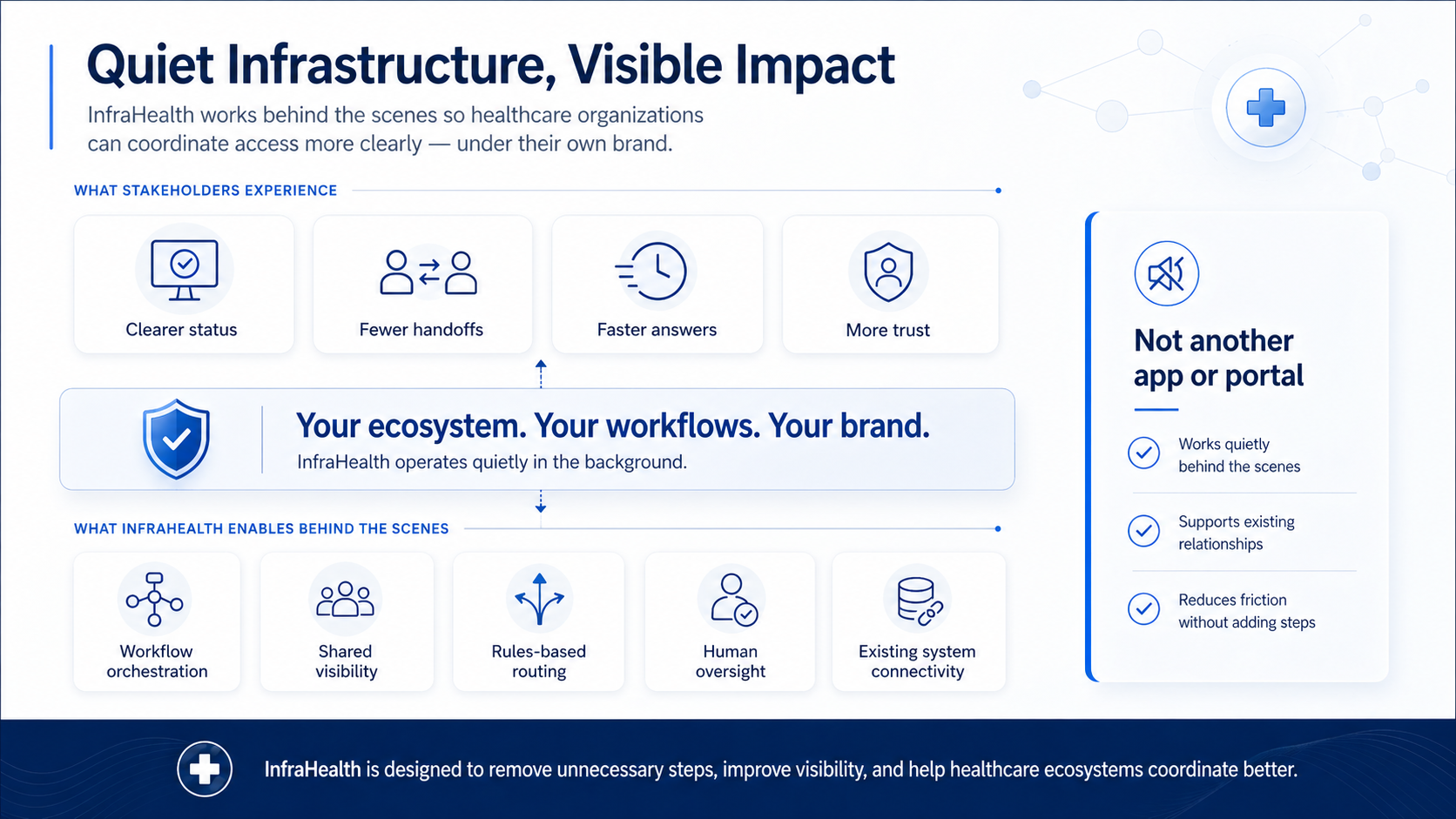
InfraHealth is not being built as another consumer healthcare app, generic consulting firm, or AI chatbot looking for a workflow. It is designed as quiet healthcare infrastructure.
That means InfraHealth works behind the scenes to help organizations coordinate access, verification, authorization, claims, payment clarity, and administrative workflows under their own brand. The organization keeps the relationship, the trust, and the experience. InfraHealth supports the infrastructure behind the scenes.
Why Now
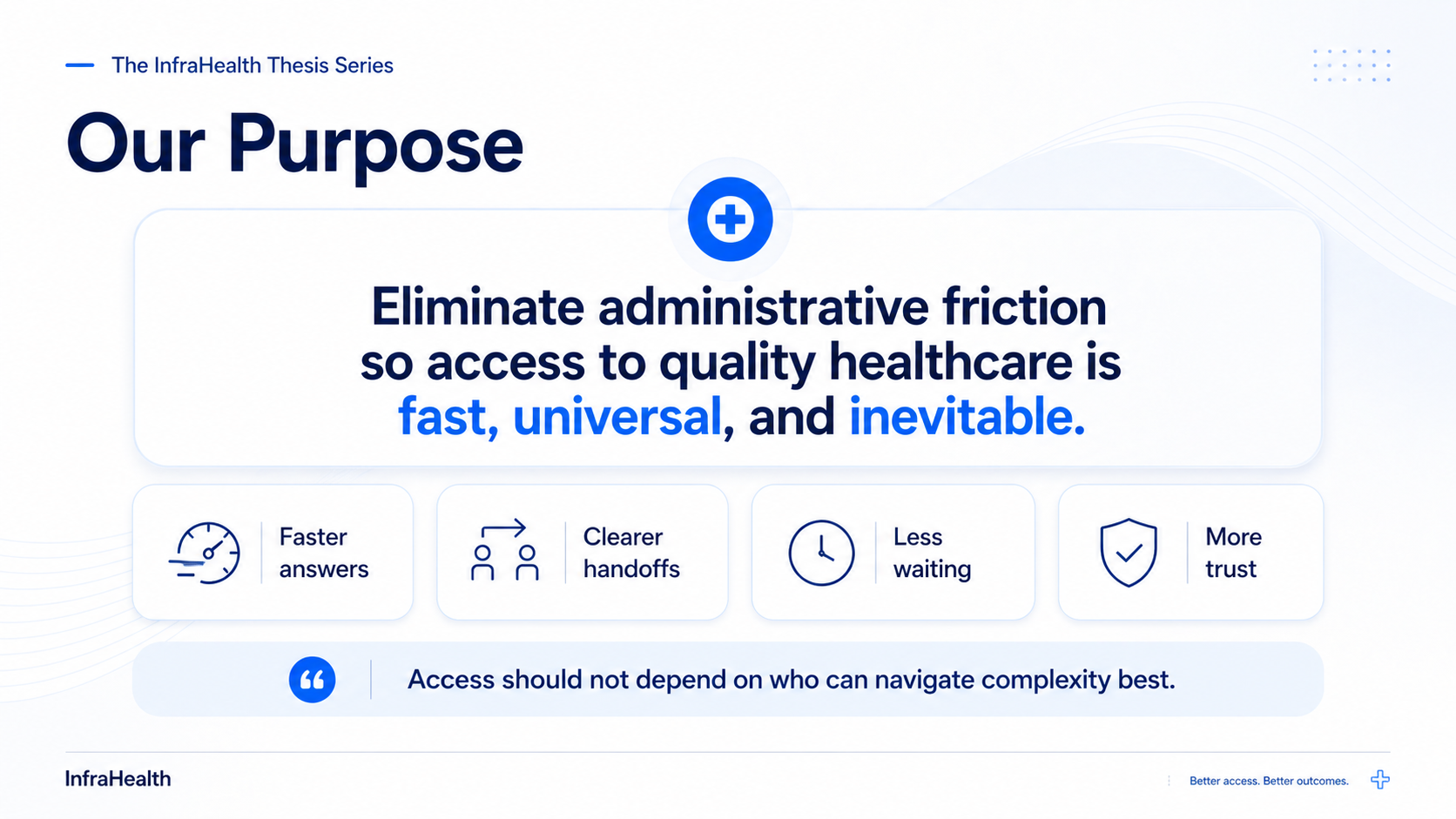
Healthcare organizations are facing pressure from several directions at once. Patients expect clearer answers. Providers need less administrative uncertainty. Payers and employers need better visibility before costs escalate. Administrators are being asked to do more with systems that were not designed to coordinate the full journey.
The industry is also moving toward more transparency, interoperability, and electronic prior authorization. AI is creating new possibilities, but AI alone will not fix healthcare administration. It cannot repair a workflow no one owns, create trust if rules are unclear, or replace human accountability where judgment matters.
Where is administrative friction slowing access, and how can we remove it responsibly?
Our Purpose
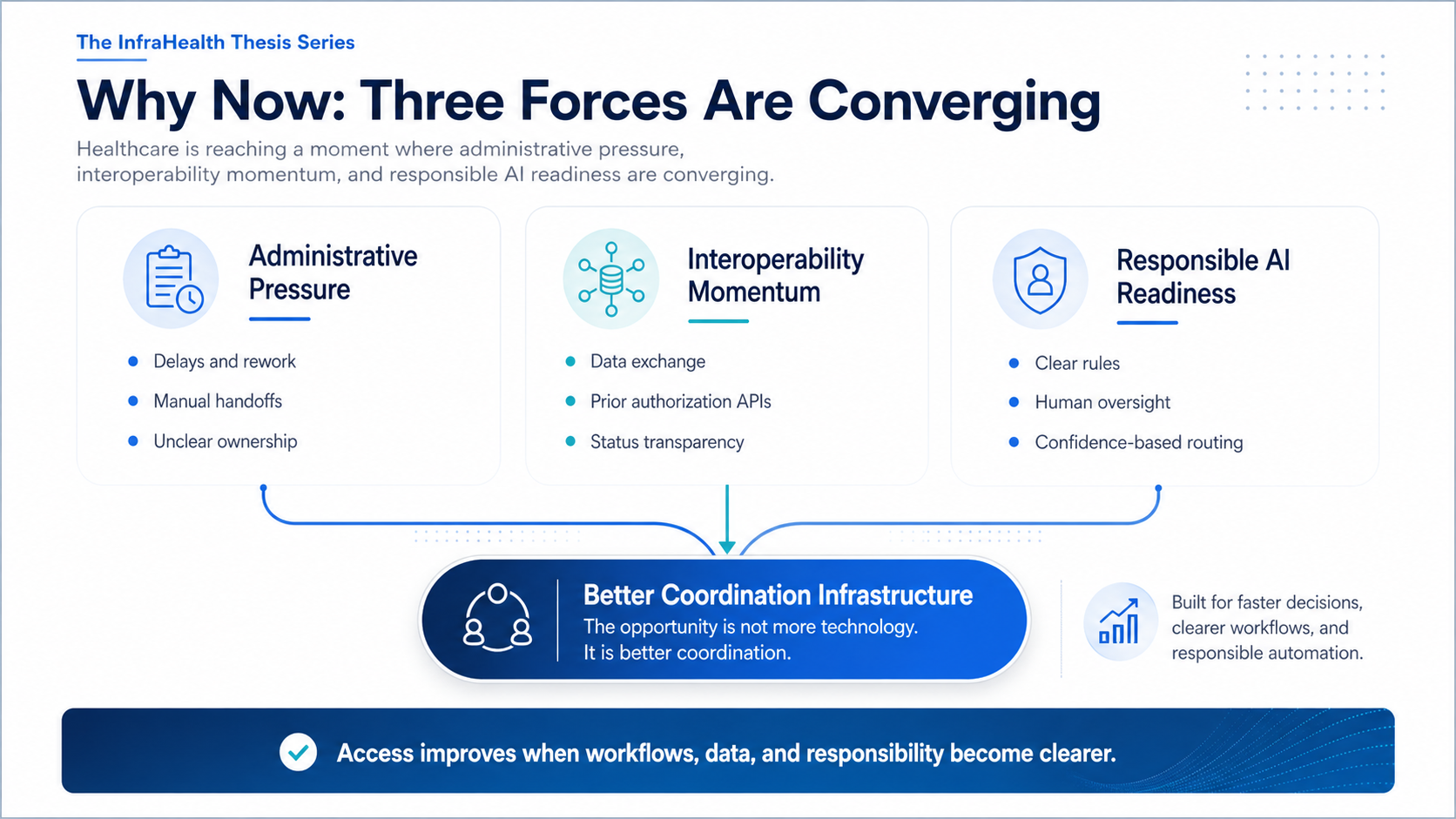
InfraHealth exists to eliminate administrative friction so access to quality healthcare becomes faster, clearer, and more reliable.
That means fewer unnecessary delays, fewer unclear handoffs, fewer patients waiting without answers, fewer staff members chasing status across disconnected systems, fewer providers distracted from care, and fewer employers and payers reacting after the fact.
This is not just a technology mission. It is an access mission. Administrative friction does not stay inside the back office. It reaches patients, families, providers, employers, payers, and administrators in very real ways.
Conclusion: The Work Ahead
That is why I launched InfraHealth. This first article begins The InfraHealth Thesis Series, a founder-led exploration of why healthcare access slows, where administrative friction hides, and how better coordination can help.
The next article will focus on a core belief behind InfraHealth: patients should not be the integration layer. Too often, patients and families are asked to carry information, chase status, repeat their story, and connect organizations that should already be coordinated.
The future of healthcare access will not be built by asking every stakeholder to work harder. It will be built by helping the ecosystem coordinate better.
Talk to InfraHealth ->